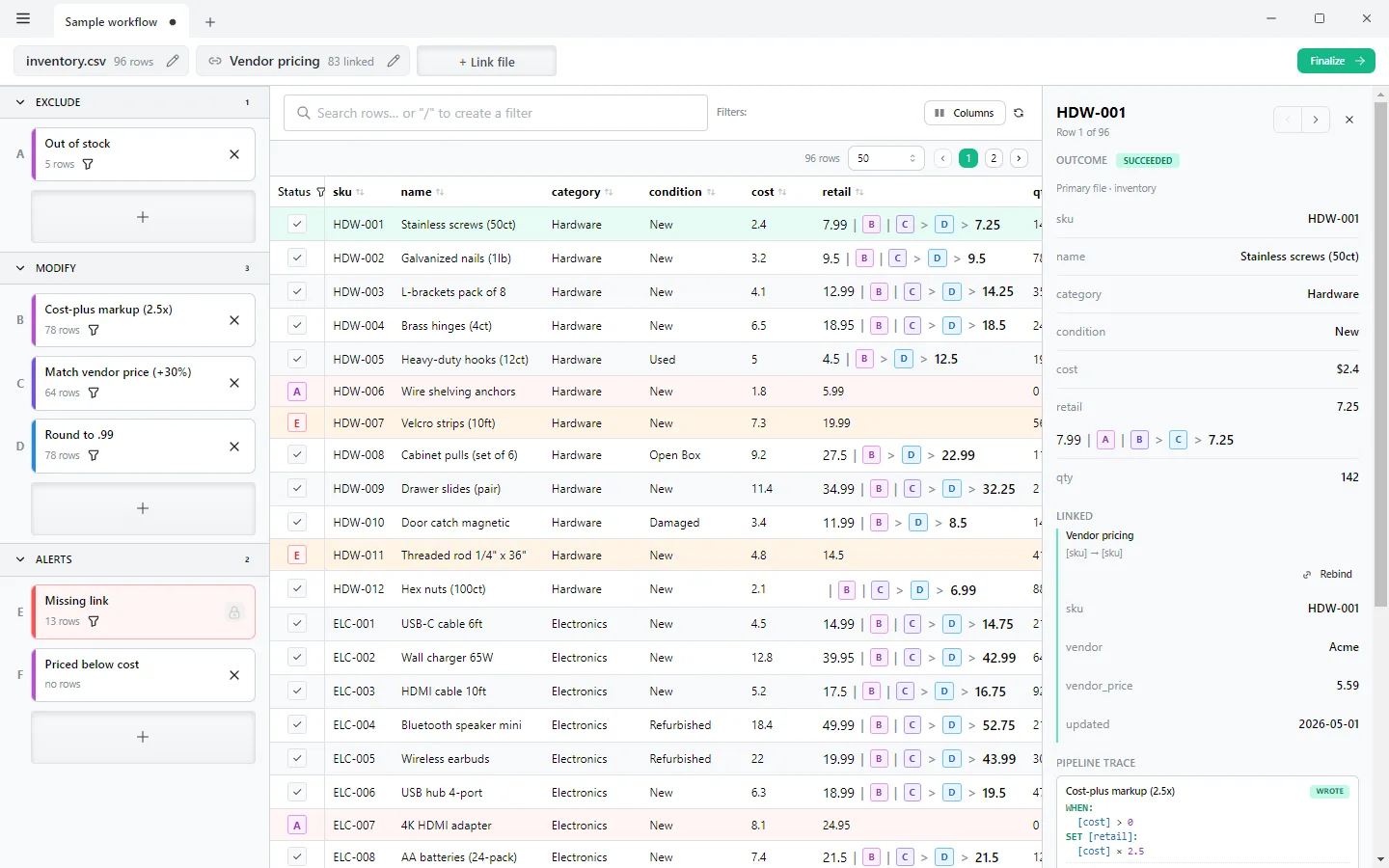
A desktop app for building repeatable CSV workflows without writing code: typed rule blocks on a visual canvas, a row-by-row explanation of every change, and a replayable audit of every export.
Private client work. Tabula shipped to a client as a Windows installer and is in beta. The source is private, and every screenshot here uses the app's generic sample data (a fictional hardware store).
Overview
Plenty of businesses run on spreadsheets that someone updates by hand: re-pricing inventory, dropping rows that shouldn't ship, flagging anything that looks wrong. Tabula turns that routine into a workflow you can rerun.
You open a primary CSV and link reference files joined on a key column. Then you build three kinds of rules: Exclude rules drop rows, Modify rules rewrite values, and Alerts flag rows without changing them. Every cell shows how its value changed, and the Inspector traces exactly which rules touched a row and why. When you finalize, Tabula writes the output CSV and saves an audit you can reopen later, read-only.
I built it solo between April and July 2026: 236 commits across 23 planned phases.
- Primary + linked CSVs
- Exclude · Modify · Alert rules
- Inspector trace
- Export + audit
Technical Highlights
- Unit tests
- ~810
- Playwright scenarios
- ~60
- Commits
- 236
- Logged decisions
- 60+
- A typed rule language with a visual editor. Rules are trees of typed blocks: WHEN and SET, And/Or/Not, comparisons, arithmetic, rounding, and aggregators. Slots are colored by type, so blocks only fit where they make sense. Blocks that aren't connected stay on the canvas, dimmed and inactive, like code outside
main(). Older rule formats migrate forward automatically. - Evaluation that tolerates messy data. A missing link, a type mismatch, or a divide by zero is a typed failure, not a crash. Boolean logic is three-valued, a failure that reaches a rule's condition or output becomes a typed automatic exclusion, and an engine error rolls that row back while the run continues. Every rule leaves a per-row trace for the Inspector.
- Replayable audits. Finalizing stores a compressed snapshot of the inputs and the workflow, plus the engine version and a SHA-256 hash of the export. Past results are rebuilt by re-running the engine, and tests verify that replays reproduce the original output exactly.
- One file per document. Each
.tabuladocument is a self-contained SQLite database with the CSVs embedded as compressed blobs, a versioned schema that migrates in place, and crash recovery for unsaved work. - Configurable editions without forking. The same engine can ship a domain-specific profile of default settings, column-name aliases, and preset rules, without changing the core or the branding.
- Tested end to end. About 810 unit tests, plus about 60 Playwright scenarios that drive the real Electron app through test-only hooks. The same harness regenerates the in-app Help screenshots. electron-builder produces a Windows installer and macOS builds for Intel and Apple Silicon.
Process
Tabula started as a single-purpose tool and was redesigned partway through into a general rule engine. That kind of pivot only works with a clear record of what was decided and why. I kept a scope document, a data model, and a numbered decision log with more than 60 entries, which code comments cite directly, and designed major changes in Figma and planning documents before building them. I used Claude Code throughout, with those documents as the shared context.